
Source: www.morningstarnews.org
Date: July 22, 2026
Christian leaders acquired all permits.
By Our Indonesia Correspondent
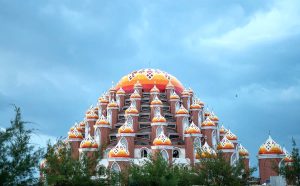
The 99-dome mosque in Makassar, South Sulawesi Province, Indonesia. (Kementerian Pariwisata dan Ekonomi Kreatif Indonesia, Creative Commons)
SURABAYA, Indonesia (Morning Star News) – Muslims in Indonesia on July 7 protested construction of a church building in South Sulawesi Province, falsely claiming it had not fulfilled legal requirements, sources said.
The Muslims also baselessly accused the church of manipulating supporting documents, excluding locals from the permit process, failing to conduct outreach, and asserted the land for the proposed worship building was merely a residential house.
The protest occurred despite local authorities granting a construction permit after concluding all legal conditions had been met, several sources reported.
The demonstration by several dozen people who said they were local residents took place on July 7 at the village head office at Kompleks Mangga Tiga Blok BI No. 1, Jalan Mangga, Paccerakkang village, Biringkanaya District, Makassar, the capital of South Sulawesi Province, according to various sources.
Carrying a banner containing their signed statement of opposition, the protesters demanded the cancellation of plans to build the Toraja Christian Church, Lanraki Congregation, on Lorong VI Street, Paccerakkang, Biringkanaya District, Makassar. The protesters said the church should not be built in their area.
In response, the local Forum for Religious Harmony (Forum Kerja Sama Umat Beragama, FKUB) said the church’s management had completed all legally required documents and it had issued a recommendation for construction on April 14.
“All requirements for building the church have been met, and the church even put up a construction notice banner for a month, so the FKUB plenary could proceed and issue a recommendation to the city government,” FKUB Makassar Vice Chairman Hasan Pinang told reporters, according to BBC.com.
Hasan said the church applied for the recommendation in January and that FKUB followed up with a field verification and a public meeting in February.
“At that meeting, both residents who supported and those who had not yet stated a position were present,” he added, promising to continue socialization and mediation to find a resolution, according to the Facebook account Christianity in Indonesia.
FKUB Makassar Chairman Arifuddin Ahmad handed the recommendation letter to the head of the church construction committee, Makis Wata, on April 14 after completing the socialization process, according to KarebaToraja.com.
“There was a month of outreach about the planned construction of the Toraja Christian church in Paccerakkang. By the deadline, no written letters of objection had been submitted to FKUB Makassar,” Arifuddin said when presenting the recommendation.
To prevent manipulation of data by opponents, FKUB would accept only written objections with signatures and wet stamps or barcodes, Arifuddin told KarebaToraja.com. Based on that recommendation, the church committee posted a banner announcing the planned construction on the provided land for one month. The banner instructed protesters to submit written objections to FKUB Makassar at Jalan Teduh Bersinar, Blok J No. 2, Makassar.
No responses or objections were submitted to FKUB by nearby residents, BBC.com reported.
Affirming that the church had received an official recommendation, the Chairman of the Fellowship of Churches in Indonesia for South and Southeast Sulawesi, Yohanis Metris, expressed disbelief that a group claiming to be local residents still opposed the construction.
“I’m confused by the community’s disposition. We followed all legal procedures. The authorities have already approved it,” Makis Wata told Morning Star News, adding that meetings had been held with various stakeholders.
One resident who wished to remain anonymous claimed the opposition stemmed from the area being majority Muslim, having no local Christian congregation, lacking required government documents, and the alleged unilateral manner of the planned construction without neighbors’ consent.
Without showing supporting evidence, the resident accused the church of paying Muslims between Rp 100,000 and Rp 500,000 (about $6.50 and 33) to support the project.
“We reject it because they are outsiders wanting to build a church in our area. That’s why people are angry. This is not arbitrary rejection; why build a church without consent, unilaterally like that?” the resident said, as reported by BBC.com.
The resident also said the land intended for the church had previously been used as a chicken coop.
“After the chicken coop, it became a meeting place, like a hall. They used it for worship because it’s far from the village. Now they want to build a church,” he said.
There have been two previous acts of opposition since the church committee began preparing the required government documents in 2022. The first, according to the Makassar Legal Aid Institute, involved installing a banner on Feb. 4, 2025, which local residents removed shortly after. The banner warned that the presence of a church would spark interreligious hostility.
David Herson Tonius, advisor at the Presidential Communications Office, followed up the case by calling the church construction committee chairman, Makis Wata, and later urged the public to monitor developments via his Instagram account, davidherson_official.
“We must keep an eye on this so the construction of the Toraja church in Paccerakkang, Makassar, can continue. It was rejected even though it has permissions and complete documents. The state guarantees every citizen the right to worship according to their beliefs, and freedom of worship is a right of all citizens,” he said.
Reacting to David’s post, richamariana12345 urged the government to act firmly.
“The government must be strict, because it looks like things are being allowed to slide. Honestly, the government has been lenient. People assume they can reject and expel those who disagree... Aren’t they ashamed to be frightened by another faith’s worship? How weak is your faith? It’s worrying that intolerant groups are growing. What will our country become if we keep hating each other...!!!”
Indonesia for All Movement (Pergerakan Indonesia untuk Semua, PIS) also questioned why the case had arisen.
“If all state-required conditions have been met, why the construction of a house of worship still be obstructed?”
Blaming the Joint Regulation of the Minister of Religious Affairs and the Minister of Home Affairs (PBM) Nos. 8 and 9 of 2006 for complicating construction of minority houses of worship, the group also criticized FKUB as adding an extra bureaucratic layer.
PIS noted that FKUB’s composition, based on the number of adherents in a region, often leaves minorities with far fewer representatives in heavily single-faith areas, creating potential for majoritarian influence on recommendations despite FKUB’s stated aim of preserving harmony. Another frequent criticism is that the right to build a house of worship effectively depends on neighbors’ acceptance.
“Even when administrative requirements are complete, the church construction can still be blocked by on-the-ground rejection,” they said.
Reports show the Toraja Christian Church Lanraki congregation has used the site since 1998, when the area was sparsely populated. Yohanis said the congregation used a building there for worship without receiving objections.
“I thought their worship went on without issue,” he added.
But Yohanis said the situation changed when the congregation sought to upgrade the building into a formal church.
“The plan to build the church has been in discussion perhaps two or three years,” he told BBC.com