
Source: www.MNNonline.org
Date; July 28, 2026

Sudan (MNN) — The Sudanese army advances in North Kordofan state, easing fears of an imminent genocide in El Obeid, the rebel-held capital city. Months of fighting for control of El Obeid are weakening the city’s infrastructure, putting hundreds of thousands at risk.
A strategic desert city connecting Khartoum to Darfur state, El Obeid’s prewar population numbered close to 500,000. Now home to hundreds of thousands of displaced Sudanese, humanitarians say El Obeid’s population has likely doubled.
“With the incredible massacre of El Fasher at the end of last year, there was a movement of [displaced people and] refugees east into the same area where they are now, and so it’s kind of a multiplication of suffering,” says John, a Gospel worker focused on Sudan.
Arabization and ethnic violence
Genocide fears in El Obeid are tied to a wider push for Arabization by Rapid Support Forces, he adds. Arabization elevates the Arabic language and culture over those of ethnic Sudanese communities.
“When you look at the genocide that took place back in the early 2000s, it was Muslim on Muslim. The tribes of Darfur were some of the strongest Muslim believers, but although they embraced Islam, they resisted Arabization. The same is true of Kordofan,” John says.
“That area (Kordofan), even under Bashir, was constantly bombarded and attacked by the government to dominate the Black African tribes.”

Arabization elevates the Arabic language and culture over those of ethnic Sudanese communities.
(AI photo generated by Chat GPT)
Sudanese governments have frequently linked Arab identity with Islamic law and institutions. Omar al-Bashir’s regime promoted an explicitly Arab-Islamic state after taking power in 1989, pitting government forces against ethnic minorities.
While the RSF currently hunts non-Arab communities, both sides reportedly target civilians. Government allies carried out crimes against ethnic minorities in 2025, while air strikes by the Sudanese Armed Forces killed hundreds of people throughout the year.
Compassion opens doors for the Gospel
John’s group supports church planters in five displacement camps, where humanitarian needs are compounded by ethnic conflict.
“At our center, we face a great opportunity, and yet it’s at a time where there’s great need and suffering,” John says.
In one displacement camp with four wells, only the well operated by believers works.
“We have to have a person who just regulates the line of people trying to get water so that there aren’t fights,” John explains.
Amid the hardship, hope remains. Years of hatred and division have created a deep longing for peace.
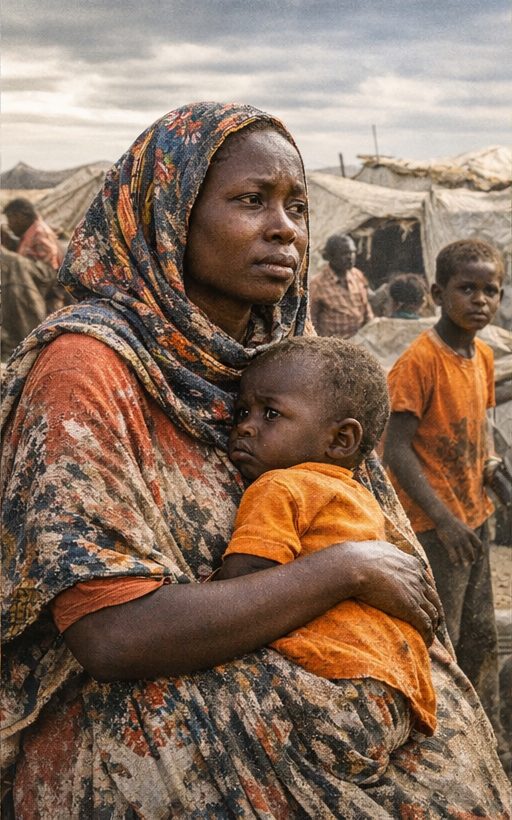
(Representative AI photo created with ChatGPT)
“Muslims come weeping, and they go, ‘Why are you doing this? You’re not asking us for anything. We know that you’re a Christian, and we’re Muslims. Why?’” John says.
“In that [disparity], they see the love of God.”
How to help
Sudanese Muslims are turning to Christ as they see His love in action. Pray church planters will speak and teach boldly about Jesus. Support them financially through John’s organization here.
At a school of ministry operated by John’s organization, he says, “We’ve graduated 350 (Muslim-background believers) from 90 different tribes of Sudan.”
After graduating, “They went back to their areas. They’ve done church planting. They’ve created networks, and now they themselves are refugees and internally displaced. And they continue the ministry.”
Header image is a representative AI photo generated by Chat GPT.