
Source: www.MNNonline.org
Date: July 31, 2026
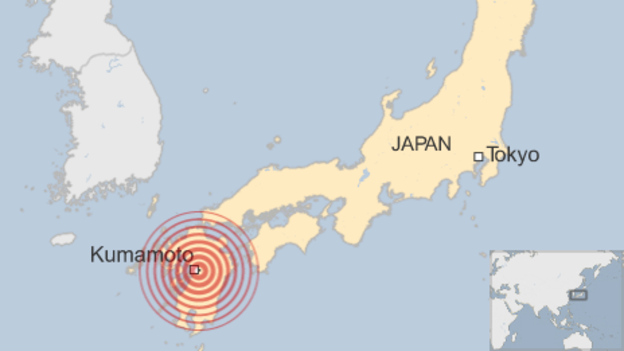
Japan (MNN) — Hope fades for survivors in southern Japan as earthquake rescue efforts shift to recovery. The death toll from Tuesday’s twin tremors in Kyushu had risen to 34 at the time of publication and was expected to climb.
A powerful 7.1-magnitude earthquake struck Kyushu on Tuesday afternoon, trapping people in collapsed buildings and briefly triggering tsunami advisories along parts of the coast. A 6.1-magnitude earthquake followed in quick succession, along with scores of aftershocks.
Shelters are overflowing as authorities inspect transport links and infrastructure.
“I’ve gotten reports of some Japanese temples that were either completely destroyed in one case, or the gates were destroyed in another. They’ve even suspended the bullet train, which is a key form of transportation,” A3’s Joe Handley says.
New threats: aftershocks and heat
Today, aftershocks and sweltering summer heat pose the biggest threats to responders and quake survivors. “They’re anticipating further quakes to hit” Kyushu, Handley says.
“The tremors that might follow could be up to seven or eight on the Richter scale; that would supersede the original quake.”
The threat of additional tremors compounds another urgent concern: extreme heat. Officials urge survivors and relief workers to take precautions against heatstroke, but utility damage makes that difficult.

A woman in Kyoto, Japan, finds relief from the summer heat using a personal fan and an umbrella to shield herself from the sun.
(Photo courtesy of note thanun/Unsplash)
“Almost 35,000 homes are without electricity, 15,000 of them without any running water,” Handley says.
More than 9,000 people “have left their homes and are stuck in about 400 shelters across the area.”
Japan’s defense minister, Shinjiro Koizumi, announced on Wednesday that the government would deliver 300 air conditioners to Kumamoto, with 150 of the units bound for evacuation centers.
AEON Mall in Kumamoto drew global attention in the quake’s immediate aftermath. “They were there in droves because the mall is a great place to escape the heat,” Handley says.
“Fortunately, they’ve already evacuated over 3,000 people.”
Previously damaged by a series of earthquakes in 2016, the mall had reopened last month. Thousands were inside the shopping center when the first earthquake hit. Then, the second floor collapsed, trapping people in the wreckage.
Re-living trauma
While responders meet physical needs, pastors in A3’s disaster relief network provide spiritual care. Some survivors told A3 that this week’s earthquake made them relive a nightmare.
The July 28 tremor “comes 10 years after a terrible quake that hit the Kyushu Island, which was devastating. Over 50 people died, and the destruction that happened was huge,” Handley says.
“Reports are [coming to us] from people who lived through that one, saying things like, ‘I thought I was going to die. It was worse than the 2016 quake.’”
Ask the Prince of Peace to comfort earthquake survivors. Follow MNN on X, Facebook, or Instagram for more updates.
“There’s a lot of concern going around, and I’m sure more will follow. We really appreciate you being willing to spread the news because the people need prayer,” Handley says.
Header image courtesy of A3.